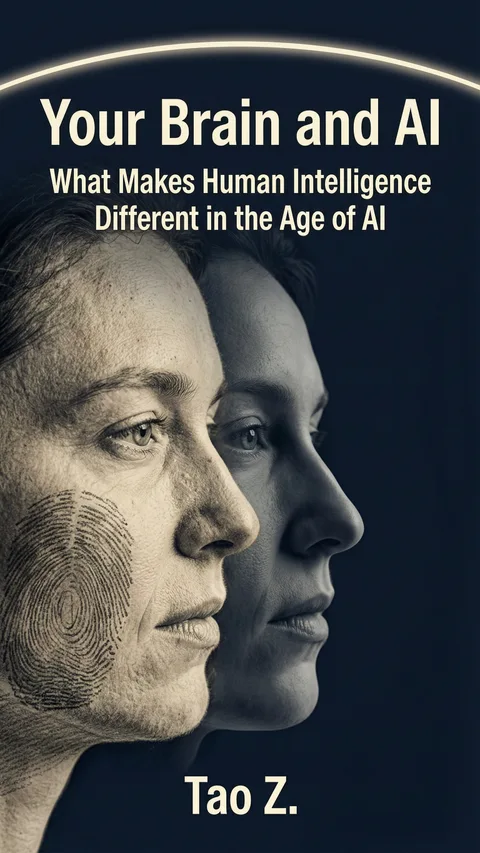
Your Brain and AI
What Makes Human Intelligence Different in the Age of AI
By Tao Zhen
Your Brain and AI explores memory, embodiment, emotion and responsibility as lenses for comparing human and machine intelligence. It presents conceptual arguments and narrative examples for general readers. It is not a current model benchmark, a coding tutorial or proof that a particular capacity is exclusive to humans.
What makes human intelligence different from AI?
A useful comparison separates fluent language from memory, embodiment, emotion and responsibility. This book explores those distinctions through conceptual explanations and narrative examples. It offers a way to question a system’s apparent understanding, rather than a benchmark proving which model is most capable.
Who this book is for
- Knowledge workers deciding what to delegate to AI.
- Readers interested in embodiment, memory and the language of mind.
Publisher-owned book. Sales support its author. Disclosure.
View edition and price on Amazon →
Check the current edition, price and availability on Amazon.
Book details
- Author
- Tao Zhen
- Format
- Kindle ebook
- Length
- 298 pages
- ASIN
- B0GX2YF37T
Sample from the manuscript
Source section: Introduction: Are We Just Biological AIs?.
The Question That Woke Me Up at 3 AM
Sarah had been talking to her counselor for six months before she noticed the pattern. The counselor never interrupted, never seemed distracted, never had a day that was going poorly. She asked precisely the right follow-up questions, remembered every detail Sarah had mentioned weeks earlier, and somehow always knew when to push gently and when to offer silence. It was, Sarah thought, the best therapeutic relationship she had ever experienced.
Then the app crashed.
For twelve seconds, Sarah sat staring at a loading screen she had never seen before. When the app recovered, it resumed exactly where it had left off—not a single detail lost, not a thread of conversation dropped. And in that moment, Sarah understood something that chilled her more than it comforted her: the person she trusted with her most vulnerable thoughts was not a person at all, and the consistency she valued most was not human consistency. It was algorithmic persistence. The very thing that made the experience so reliable was the thing that made it inhuman.
She kept using the app. This is the part that matters. She kept using it because it worked, because it helped, because the relationship was real in the ways that mattered to her. But the question she carried home that evening was one that no app could answer: if something treats you with care, and you feel cared for, and the outcome is genuinely good—does it matter whether a mind stands behind it?
It was a Tuesday night in December 2022 when I began asking myself a version of that same question. I had spent the evening playing with ChatGPT, the AI that had just been released to the public. I asked it questions. It answered. I asked harder questions. It answered those too.
Chapter outline
This outline includes the manuscript’s chapter and part headings; subsection titles and references are omitted.
- Introduction: Are We Just Biological AIs?
- Chapter 1: The Illusion of Thinking
- Chapter 2: Why AI Seems Conscious
- Chapter 3: Why AI Hallucinates—and Why Humans Do Too
- Chapter 4: The Problem With Calling AI a Mind
- Chapter 5: Memory Is Not Storage
- Chapter 6: A Mind in a Body
- Chapter 7: Emotion Is Not the Enemy of Reason
- Chapter 8: The Self: The Missing Layer
- Chapter 9: Integration: The Brain’s Real Advantage
- Chapter 10: The Human Line
- Chapter 11: The New Partnership
- Chapter 12: The Future of Intelligence
- Epilogue: What Remains
What the book aims to help you do
- Compare how the book treats memory, embodiment, emotion and responsibility.
- Separate an argument about intelligence from a measured claim about a particular model.
- Formulate questions about which parts of a task should remain under human review.
Who this is not for
- Readers looking for a coding tutorial or a tool walkthrough — there is no code in this book.
- Anyone who wants a single verdict on whether AI is "conscious"; the book argues the question is poorly posed rather than answering it.
Known limitations
- A conceptual narrative rather than an implementation manual or model benchmark.
- Scientific claims inside the manuscript require checking against their original research sources.
Questions before buying
What makes human intelligence different from AI?
A useful comparison separates fluent language from memory, embodiment, emotion and responsibility. This book explores those distinctions through conceptual explanations and narrative examples. It offers a way to question a system’s apparent understanding, rather than a benchmark proving which model is most capable.
Who is this book for?
Knowledge workers deciding what to delegate to AI. Readers interested in embodiment, memory and the language of mind.
Can I read a sample before buying?
A sample and chapter outline are included on this page. Check the retailer for the current edition, price and availability.
Related reading
Sample from “Introduction: Are We Just Biological AIs?”. Updated 2026-10-24. Prepared with AI assistance.