What to delegate to AI, and what to keep for yourself
Delegate a task to AI when the output is cheap to verify, errors are recoverable, and the task is not the point. Keep tasks where the doing is the learning, where judgment is the deliverable, or where being wrong is expensive and hard to detect. Verifiability matters more than capability.
Key facts
- Framework scope
- Three tests proposed here — verifiability, error cost, and whether the task itself is the point
- Related method
- The DEPTH method proposes five practices for reflection on thought and delegation in AI-assisted work
- Related book
- Your Brain and AI compares human and machine intelligence through memory, embodiment, emotion and responsibility
Capability is the wrong first question
The useful question is not whether AI can do this — increasingly it can produce a passable version of most things. The question is what delegation costs you. Three tests.
Test one: can you verify the output cheaply?
If checking takes less time than doing, delegate. If verifying requires the same expertise as producing, delegation saves less than it appears to. A draft you cannot efficiently proofread is not a draft; it is a liability with good grammar.
Test two: what does an error cost, and would you see it?
Recoverable errors favor delegation. Silent, expensive errors do not. The dangerous combination is high cost plus low visibility — the mistake you will not notice until it compounds.
Test three: is the task the point?
Some work is not overhead. Writing the summary is how you find out what you think. Running the numbers yourself is how you learn what they mean. When the doing is the learning, delegation transfers the cost to a place you will not see it: your own understanding.
What tends to stay
- Judgments where you are the authority — the decision is yours to own, not to route around.
- Early drafts of thinking you have not done yet.
- Anything where being wrong damages trust faster than being slow does.
The delegation audit
List last week’s AI-assisted tasks. For each, mark which of the three tests it passed. The tasks that failed one are where the time you saved is quietly being billed to your future self.
The Power of Slow Thinking builds these tests into a method. Your Brain and AI examines what the human side of the comparison actually contributes.
Read a sample before choosing
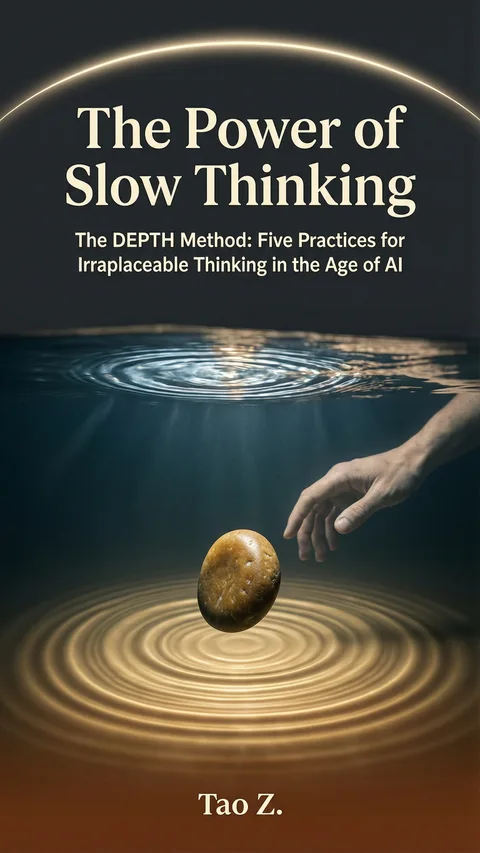
The Power of Slow Thinking
Reflection exercises for a more deliberate relationship with AI-assisted work.
Publisher-owned book. Sales support its author. Disclosure.
Sample, chapter outline and limitations →
The Reasoning Machine
A three-lens framework for asking better questions about AI reasoning.
Publisher-owned book. Sales support its author. Disclosure.
Sample, chapter outline and limitations →
Your Brain and AI
Explore memory, embodiment and responsibility in a conceptual comparison of human and machine intelligence.
Publisher-owned book. Sales support its author. Disclosure.
Sample, chapter outline and limitations →Prepared with AI assistance. Updated 2026-10-28. About our recommendations.